
Oct 5, 2026 · @Kate Page
When people see the sandtray in my counselling room, I sometimes notice a flicker of uncertainty. A tray of sand and shelves of small figures can look like something meant for children. Am I going to be asked to play?
It's an understandable reaction. But sandtray work is really something very different, and for some adults it opens doors that talking alone can't.
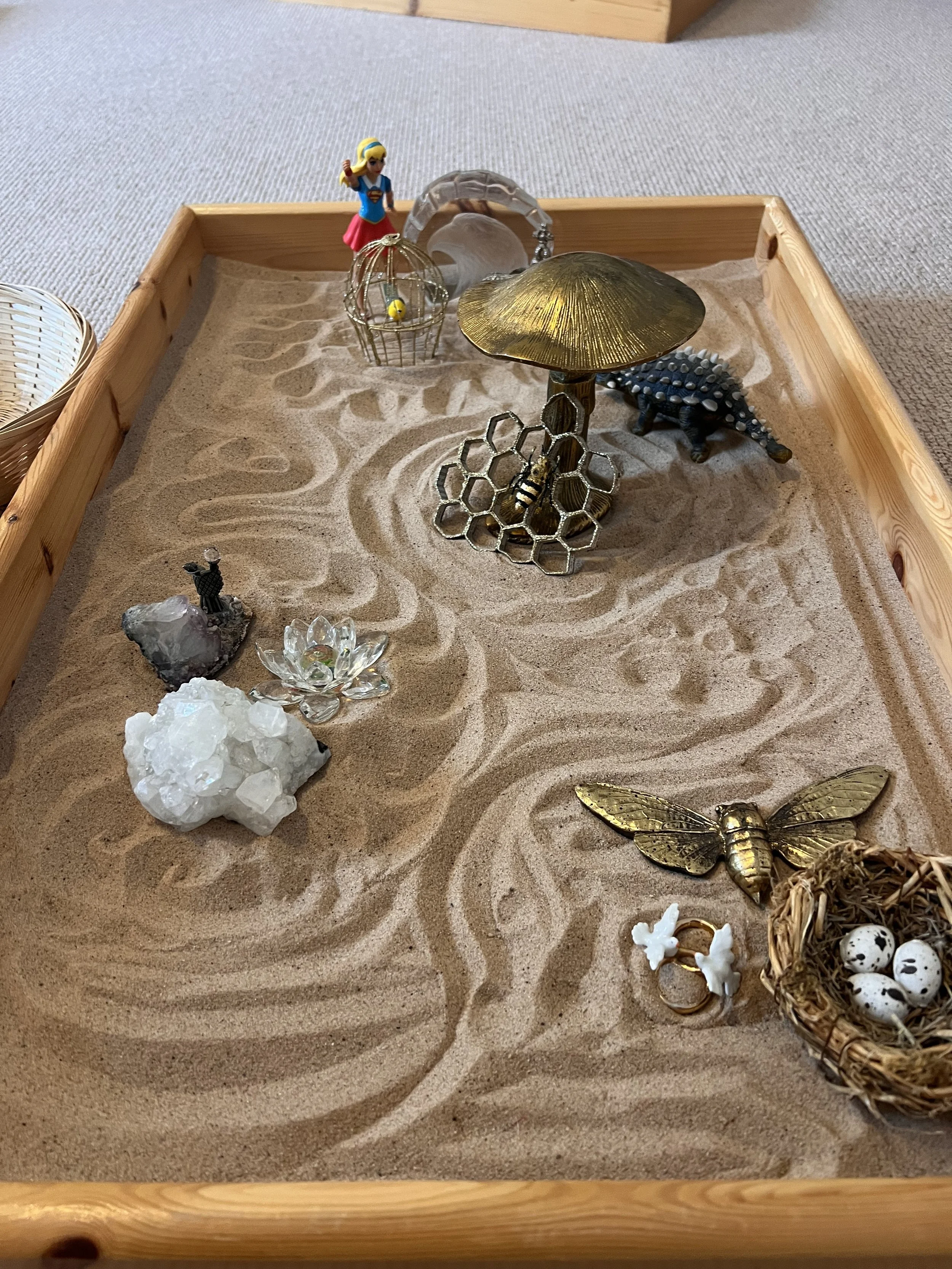
What sandtray is
The setup is simple: a shallow tray of sand, and a collection of small figures and objects. There are people and animals, trees and houses, bridges and fences, shells, stones, and things that are harder to name.
You're invited to shape the sand and place whatever figures you're drawn to, creating a scene or "world" in the tray. There's no right way to do it, and you don't need any artistic skill. Some people build something detailed and deliberate. Others more simple. Both can be meaningful.
Where it comes from
Sand and miniatures or symbols as they are called have a longer history in therapy than many people realise. In the late 1920s, the London paediatrician Margaret Lowenfeld developed what she called the "World Technique", giving children a tray of sand and figures to express their inner worlds.
In the 1950s, the Swiss Jungian analyst Dora Kalff, who had studied with Lowenfeld, brought the method together with the ideas of Carl Jung. Her approach became known as sandplay, and it's now practised with adults as well as children around the world.
The Jungian idea at the heart of it is that our inner life speaks in images and symbols, not just words. Jung wrote about finding "the image that lies behind the emotion". In the sandtray, those images can take shape where you can see them. Kalff described the therapist's role as offering a "free and protected space": somewhere safe enough for whatever needs to emerge.
My own work with the sandtray draws on this Jungian tradition. I’ve completed an accredited foundation training in sandtray therapy and I’m continuing my training with a diploma starting in December 2026
Why it can help adults
As adults, we're often very good at talking about our problems: explaining them, analysing them, even making jokes about them. Sometimes that skill can keep us at a safe distance from what we actually feel.
Sandtray can help in different ways:
• When words aren't enough. Some experiences, particularly early or traumatic ones, are hard to put into language. Working with images can reach places that talking can't.
• When you feel stuck. Seeing your situation laid out in front of you can offer a new perspective, sometimes quite unexpectedly.
• When talking feels too much. Focusing on the tray rather than on eye contact can make difficult things feel a little easier to approach.
• When you want to understand yourself more deeply. The figures people choose, and where they put them, often say something they didn't consciously know.
Many people are surprised by what appears in the sand. A symbol chosen on instinct can turn out to hold real meaning.
What a sandtray session with me looks like
If you'd like to try it, I'll invite you to take your time looking at the symbols and to choose whatever catches your attention. You don't need a plan. You can touch the sand, move things around, and change your mind as often as you like.
While you work, I stay present and quietly attentive. Afterwards we might talk about what you've made, or we might simply look at it together. I won't tell you what your tray "means". In the Jungian tradition, the meaning belongs to you, and it often unfolds slowly over time.
With your permission, I may photograph the finished tray, so we can look back at how your trays change over the course of our work.
Is it for me?
Sandtray is always an invitation, never a requirement. Some clients use it often, some once or twice, and some not at all. It sits alongside our talking work as one more way of exploring what's going on.
At the moment, I offer sandtray work to adults only.
If you're curious, you're welcome to ask about it during your free 15-minute call. You can reach me on 07930 600901 or at hello@katepagetherapy.co.uk.
Kate Page, Integrative Counsellor MBACP, Cornwall